
Nature Moments
Prologue
How does an important new concept form in the mind? This is the way it happened for me.
Last October after my son listened to my presentation on Nature Mindfulness, he said that I needed a shorter explanation and quicker more user-friendly techniques for connecting with nature. People his age, he added, wanted fast, hands-on techniques for nature experiences.
Then, a few weeks ago, feeling bored, tired, and too sleepy to read I was doomscrolling through Facebook when a post from my daughter, a mental health counselor, grabbed my attention. Her post was about “glimmers,” fleeting moments of transcendent perception that evoke feelings of serenity, awe, connection, and safety, which reduce the stress response, facilitate rest and relaxation, and heal trauma residues.
Two weeks later at a session of my men’s book club as we wandered off topic and began to self-disclose, one member, Patrick, shared how he had been trying to break out of the time compressing effects of routine and repetition by slowing down time. The method he explained was to conduct 60 second intervals of present-centered sensory self-awareness and then consciously savor those moments.
Sometime that night, the neurons holding the ideas of quick and easy, glimmers, and moments linked up, intertwined, and created the concept of “Nature Moments.”
Nature Moments
Purpose: Connect with nature through micro-moments of noticing, appreciating, and reflecting. Reduce stress, increase positive emotions, improve cognition, experience mindfulness, and reprogram neural pathways for optimal well-being.
Overview: Take a slow, leisurely walk for 10-20 minutes. Engage in sensory awareness, open your attention, notice, appreciate, and reflect on micro-moments of nature beauty and discovery.
Directions:
Form an intention.
Select a location.
Cross a threshold
Tune In
Scan for beauty, interest, and awe
Savor and Appreciate Moments
Make fields notes using DAR format (Discover-Appreciate-Reflect)
Start a Nature Moments Journal using the DAR Format
Share
Walk the Walk
It was time for me to test my new concept and take a Nature Moments walk.
Intention
I held a brief internal conversation telling myself that I was going to take a walk and dedicate 10-20 minutes to being in and connecting with nature. I knew from past readings and personal experience that forming an intention really works. Mind and heart organize around and prepare to fulfil a stated and held intention.
Location
Let’s make this easy I thought. I’ll take a short walk along a nearby trail that runs between patches of woods and overgrown, brush-filled fields. Nice diverse natural habitat, convenient and familiar.
Threshold
I walked through the village park, down a street and came to the entrance of a path where I faced a shallow ditch and a slight embankment. A perfect threshold. Stepping over the embankment and onto the path I murmured “Now it begins.”

Tuning In
Pausing, I took a few deep even breaths through my nose, relaxed my shoulders, neck, and face, felt the fresh 40-degree air on my face, looked around at the trees and fields, and inhaled the subtle fragrance of snow-covered, frozen, forest and field.
A Birdy Moment

I closed my eyes to tune in to the soundscape and immediately heard a loud kik-kik-kik-kikikki, the call of a pileated woodpecker. An image came to mind; large crow-sized bird, long spiky beak, bright red topnotch. Another call. Two pileated woodpeckers in the nearby woods.
Then I heard other birds nearby—the sharp peek-peek of a hairy woodpecker, the clear whistled peer-peer of a tufted titmouse, the strident jay-jay of a blue jay, the high-pitched rapid see-see-see of a golden-crowned kinglet, the soft tseet-tseet call of a white-throated sparrow, and the metallic tick-tick flock call of a cardinal.
A chorus of winter bird calls surrounded me. I listened to and savored the sounds. I heard them rising and falling, coming and going, from all directions around me.
Okay, now it was time to make my DAR field notes. I started by describing my (D) discovery, by listing the birds in my field notes and taking a screenshot of my Merlin bird ID readout.

Next on to the A, the appreciation. What did I feel? Positive feelings for sure, happy and a sense of enjoyment Then I discerned nuances—wonder at the diversity of songs and joy at the subtle beauty of this forest music. I also felt grateful to be in the right place at the right moment.
On to the R. Any reflections? Yes. The many calls signified an abundance of life on a gray, chilly winter day. Also, I had stumbled into what birders call “a birdy place,” a spot where suddenly many different species could be seen and heard. Why were they all here in this place and at this time? Security in numbers? An abundance of food? It is a mystery.
Fulsome Fruits
The first nature moment came easily enough. I walked slowly along the path opening my awareness to the beautiful, the interesting, and the awe inducing around me.
Glancing up I noticed thick clusters of dark purple berries that looked like bunches of ripe grapes ready for the harvest. Fecundity, fertility, abundance, vitality, continuity clustered richly on the tips of the branches. Down lower I spotted a cluster of bright orange-red rose hips.
I was surprised, impressed, and felt a sense of awe at the beauty and abundance of these fruits ready to feed the birds and ready to propagate the species.
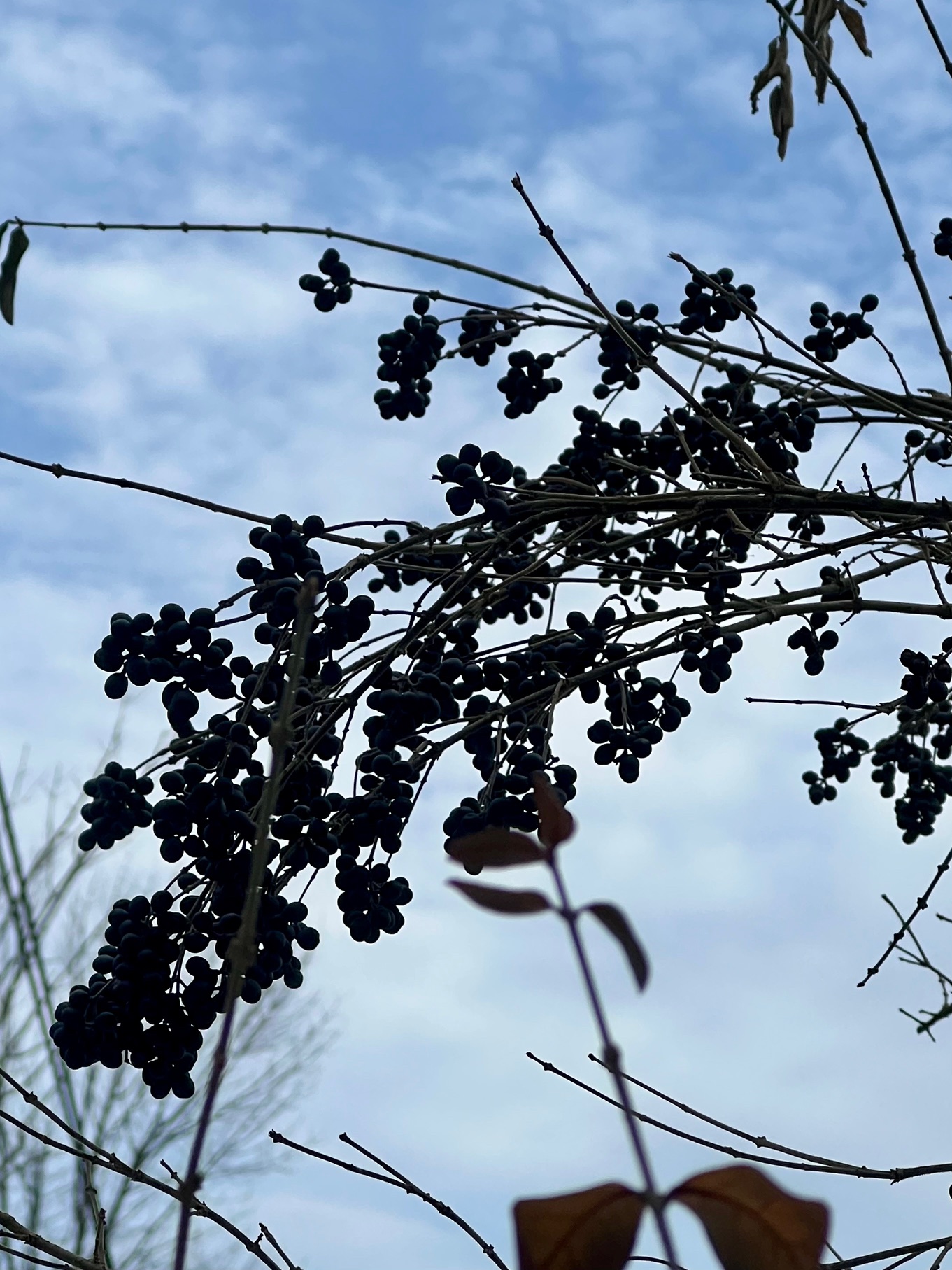

Reflecting on these fruits I realized I was looking appreciatively at two low-regarded, invasive species, privet hedge and multiflora rose, shrubs that conservationists often remove. Normally, I would have walked by these plants regarding them with contempt. But now I was wowed by their beauty.
Golden
Okay, I thought. These nature moments are popping up. The idea of discovering beauty in the commonplace seemed to be working.
Taking a few more steps down the path, my gaze fell upon a goldenrod stalk topped with a spray of dried blossoms. I moved in for a closer look. The flower spray was a light tan that contrasted beautifully with the white snow. Each tiny floweret held countless delicate, fluffy, beige seeds poised to fly if brushed up against or blown by a strong gust. More abundance, more propagation, more food for the birds and mice.
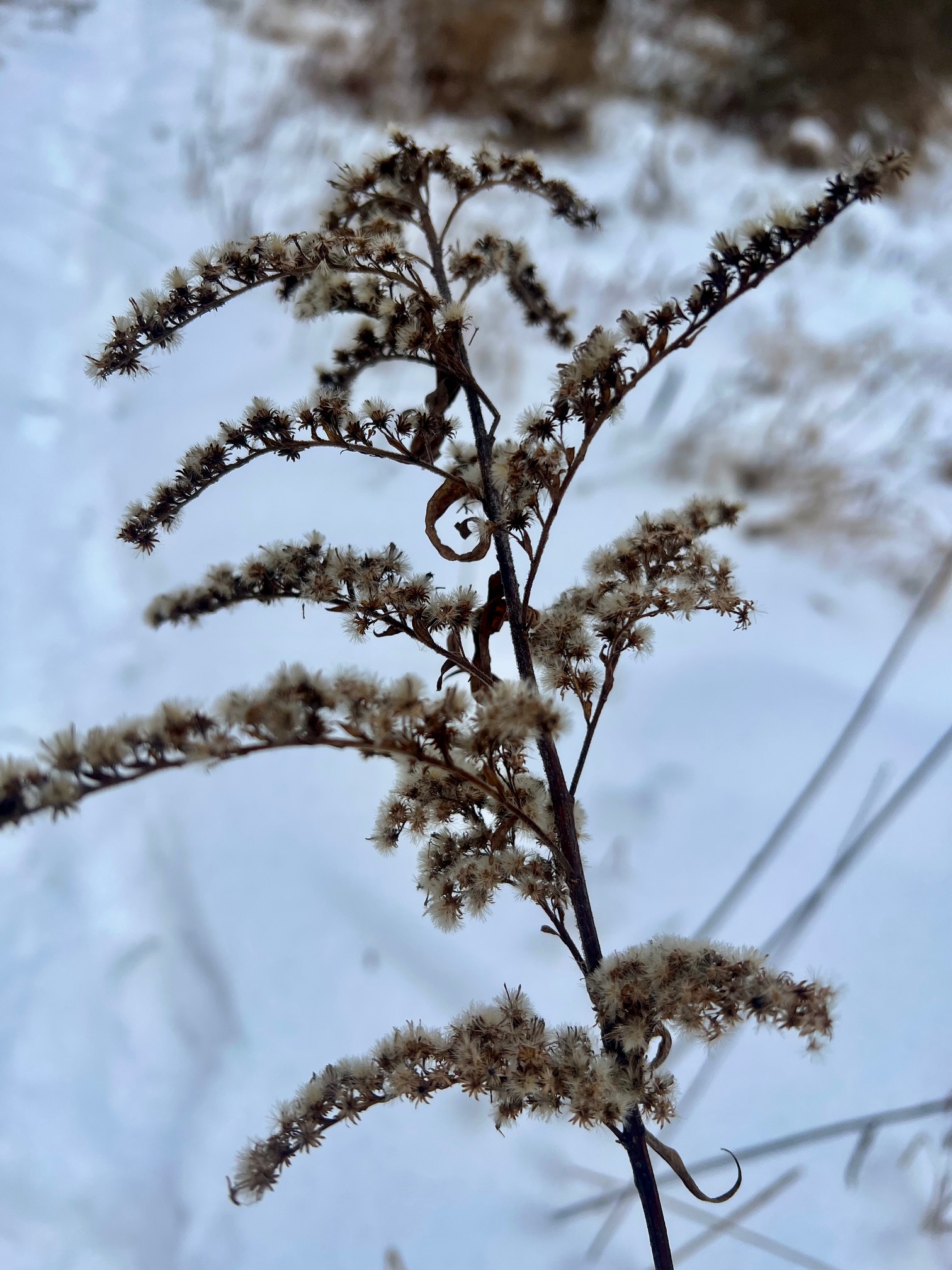
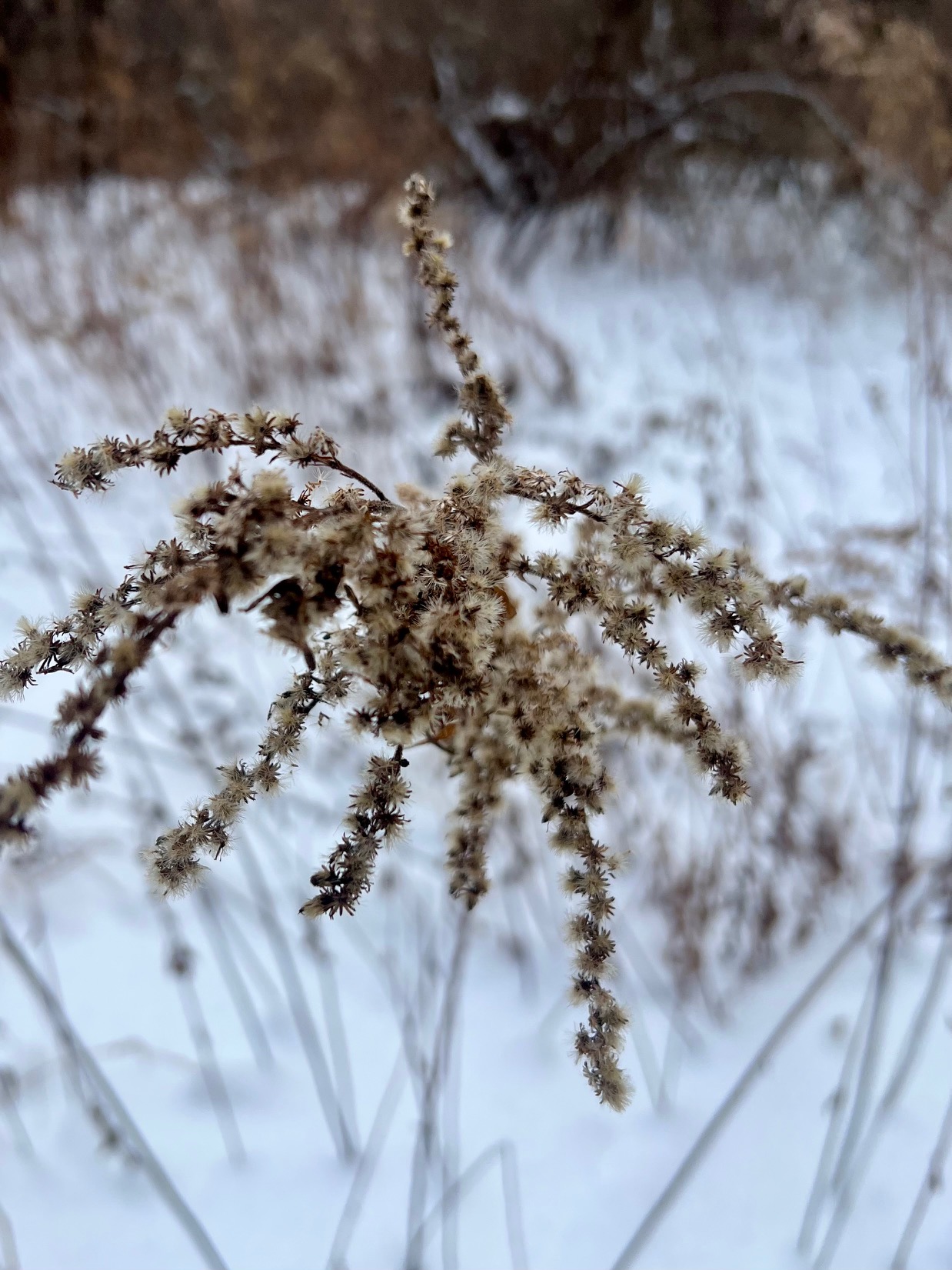
I took in and savored the view and tried to discern my feelings. Hmmm, this appreciation part could be challenging. Definitely more subdued feelings here, a blend of mild awe and wonder with a touch of soothing.
Reflecting on all of this I saw the stalk sway gently back and forth in the breeze. I noticed a brown leaf in a perfect curl, more beauty in the commonplace.
Nesting
Further down the trail I spotted a bird nest placed in a bush. A surprise. I have walked by this bush at least fifty times during the past spring, summer, and fall and never noticed the nest.
Moving in for a closer look I saw that it was a perfect bowl shape tightly woven from stems and leaves of tan grass and slender twigs artfully placed in a three-branched crotch of the bush.
This nature moment set off some high energy appreciative feelings—wonder, joy, awe, and admiration.

I reflected that instinct triggered nest building, but it sure looked like a display of avian intelligence and artistry to me. And how well the nest was hidden. I wondered what bird built it. Probably some kind of wood warbler. I would have to check into that. Always more to learn.
As a footnote, after noticing this nest I kept my eye out for other nests. A few days later I spotted a bigger nest, probably made by a robin and sure enough it was placed in a three-branched crotch. So, the placement I saw was not random. Clever birds find exactly what they need. Could this be true for people as well?
Snow Holder
I continued down the path. Nice and slow. Even breathing. Open attention.
To my left, down in the field, I noticed a large, gnarly, weathered bush, with thick gray branches bowed out almost parallel to the ground. Each branch topped with clumps of snow from yesterday’s snowfall.
I always love seeing snow on branches—so delicate, so transient. Soon a gust of wind would shake the snow loose, or the rays of the sun would melt it. This bush with its almost horizontal branches was a perfect snow holder.
Curious, I trudged through the snow, got close enough to snap a photo and let my Picture This app make an identification. It turned out that my snow holder was Common Buckthorn, a plant often vilified for its invasive nature.
I read that buckthorn is a strong competitor for natural resources. Its roots release biochemicals that suppress the growth of other plants thus reducing native biodiversity. And it produces appealing black berries that birds eat and then spread the seeds. But it also has redeeming qualities in that it can reclaim wastelands, stabilize soil, and serve as a larval host for several important butterfly species.
My feelings? I still enjoyed the beauty of the held snow and the graceful spreading shape of the branches. I admired the tenacity of its adaptive strategies and felt a subtle sense of awe for the complexity of nature.

Reflections? Here was another plant that I had walked by a hundred times and never noticed, another nature story that I had completely missed. And if I had known it was an invasive, I might have joined the vilification team. Fortunately, the beauty of the held snow had invited me into this nature story. Notice more and do not make simple snap judgements, I advised myself.
The Nature Moments Journal
Seventeen minutes had elapsed. Five beautiful, interesting, and awe inducing nature moments. Time to head home and start my nature moments journal. But I felt trepidation for this task. I knew journaling was a good thing, yet all my past attempts had fizzled out after a few days.
Still, I wanted to give it a try. I had my field notes as a starter. I thought the DAR structure of Discover, Appreciate, and Reflect would make the process easier. And I believed that writing down my nature moments would deepen and enhance the effects.
Fortuitously, I found and watched a YouTube video by John Muir Laws, an enthusiastic advocate and teacher of nature journaling based on making drawings of what you see. His video is charming as his two young daughters are bouncing around in the background proudly displaying their field drawing kits.
Laws presents a sound rationale for the value of journaling nature experiences. He explained that you could see a beautiful sunrise, think it is the most spectacular display of morning colors you have ever seen but then two days later the memory has faded away, merged into all the sunrises you have seen, and the impact lessens. Journaling cements the experience into your memory. It is a form of repetition, a known way to form memories. Once firmly in your memory the feelings of interest, beauty, and awe grow and transform your life.
Exactly I thought. One of the benefits of time in nature is to shift your perspective to notice more of the positive, to rewire your brain to see more beauty, awe, and interest around you. This in turn promotes well-being and encourages learning. Slowing down and writing purposefully by hand helps to overcome the hardwired human bias to scan for and dwell on the negative and danger.

I made a cup of tea, sat down in my office where I have a view of nature unfolding at my array of bird feeders, and drew three columns on an 8.5 by 11inch page in a spiral notebook. Pencil in hand, field notes nearby, I began to elaborate on each of my nature moments with a (D) describe my discovery, an (A) appreciate of my feelings, and (R) reflect on meaningful patterns or connections that came to mind. I also added any questions that arose.
It went well and felt good to relive my nature moments, add detail, and explore nuances. As I wrote I remembered a conversation with my friend Bill, a passionate advocate of handwriting. Bill taught teachers how to teach manuscript and cursive. He explained that the process of writing starts in your mind, flows through your heart, and then moves to the page via your motor skills. Writing, he said, is elemental, it is our first conscious experience of self-expression. He added that we need to expunge any lingering and inhibiting memories of corrective red marks and write about what we love.
Words came to mind and flowed onto the page. I discovered that I loved writing about my nature moments. I even added a few simple sketches in line with John Muir Law’s approach. Laws emphasized process over product. You are creating new networks in your brain to see more, to augment your appreciation, and to open your curiosity. It does not matter if, like me, your drawing skills never made it past level one stick figures.
Entries completed, I wrote a summary of my overall impressions. Physically, I was surprised to feel a warm glow around my heart. Emotionally, I felt enriched and encouraged by the wash of positive feelings I had experienced. The patterns and connections I noticed made me feel more joined to and inspired by surrounding nature. And I was intrigued by the many questions for further learning and exploration that arose.

Epilogue/Invitation
I hoped the Nature Moments approach met my son’s criteria of quick and easy, incorporated my daughters concept of glimmers, and supported Patrick’s goal of savoring moments. I am grateful for their input.
Dear reader, I invite you to give it a try. I have added an example of DAR field notes and a Nature Moments Journal entry in Appendix A below. Feel free to individualize, create your own system, and add personal touches. To help with discerning positive feelings in the appreciation part of your journal I added a list of positive emotions in Appendix B.
*****
Here is a link to John Muir Laws page where you can find his YouTube video.
Here is a link for more information on “Glimmers.”
https://www.verywellmind.com/what-is-a-glimmer-5323168
For information on the benefits of nature mindfulness check out my latest book, Nature’s Pathways to Mindfulness, available on Amazon and through the publisher Shanti Arts. Links below:
Nature’s Pathways to Mindfulness: Harvey, John: 9781962082266: Amazon.com: Books
Nature’s Pathways to Mindfulness, John Harvey
*******
Appendix A
DAR field notes
D: Bird nest of woven grass set in branches, covered with toping of snow.
A: Awe, wonder, and surprise.
R: Intricate construction. Well hidden
DAR Journal
Date/Time/Location 1/3/26 9:56-10:13 Bethany Woods Path
Discovery Appreciate Reflect
Bird nest woven tightly Awe and beauty. Bird intelligence on
from tan field grass. Joy of discovery. display. Artistry too.
Perfect tiny bowl shape. Wonder at complexity. What was hidden in
Placed in three-pronged Spring is now seen.
crotch of tree. What bird made it?


Appendix B
Psychologists divide positive feelings into three categories. Your feelings may be blend of these.
High Energy—awe, joy, beauty, inspiration, interest, amusement, admiration.
Low Energy—contentment, peacefulness, relaxation, serenity.
Relational—love, gratitude, compassion, empathy.
2 thoughts on “Nature Moments”
Good job, John! Nature has so much to offer and your “moments” will help people recognize that!
Thanks Mike and I hope you are right that that nature moments will encourage more people to get out there and take it all in.
Comments are closed.