
Riparian
Derived from Ripa, Latin for riverbank, the riparian zone is where a body of water, a river, stream, lake, or pond interfaces with land. This zone is a richly biodiverse corridor where water, the great life giver, profoundly influences plant and animal life. It is where water loving plants, grasses, bushes, vines, and trees flourish, where animal life from tiny under the rock invertebrates, to fishes, frogs, racoons, deer, foxes, and coyotes prosper, and where waterbirds, shorebirds, and songbirds sing, feed, nest, and raise their young.
For the last two months, the word riparian had been floating around in my mind, surfacing in everyday thoughts, drifting in and out of dreams, calling out to me to conduct a sit spot, to offer my attention, to let the moving water teach me. Yet, somehow, I had not found the right setting or the right time.
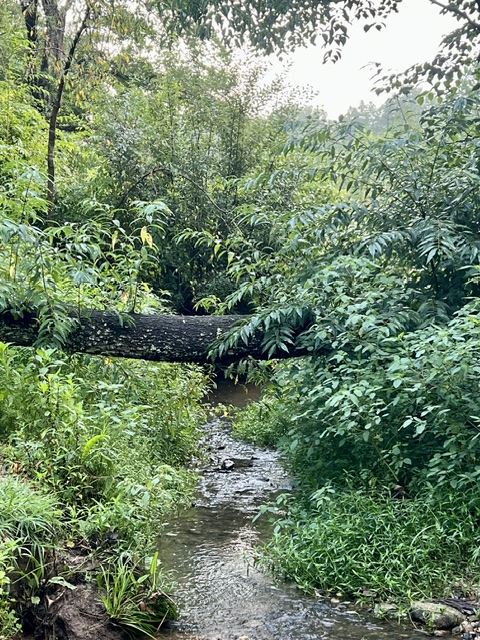
Now, an opportunity presented itself. A little stream surrounded by verdant riparian life flowed along the edge of the yard of the new house in Hendersonville, NC. I weed whacked a path down to the stream, trimmed a few low hanging branches, cleared a spot next to the water, and placed a bench creating a little creekside pocket park, a good place for a sit spot.

First Impressions
6:32 a.m. I am seated on the bench next to the creek in dim predawn light. A blanket of gray clouds overhead. 65 degrees. 100% humidity. Drops from last night’s rainfall slip off the leaves, land on my shoulders, plop onto the water, and form circles that spread and vanish.
I take a few even, deep breaths and practice sensory awareness. The sounds dominate. From two mini-rapids in the creek the flowing water murmurs, trickles, and gurgles. Listening carefully, I hear that each tiny rapids sings its own unique notes. Together they create a constantly changing water music.

The birds launch their morning chorus. The first singer is a cardinal whistling a loud, clear birdy, birdy, birdy. A while-breasted nuthatch calls a quieter, nasal, ank, ank ank. A tufted titmouse whistles clear, clear, clear. An Eastern Towhee chants its cheery drink-your-TEA. Crows caw, caw caw in the distance.
Nearby a Carolina chickadee calls a rapid-fire chick-a-dee-dee-dee. A Carolina wren sings a loud, insistent tea-kettle, tea-kettle, tea-kettle. A blue jay cries jay, jay, jay.
The morning bird songs and the babbling brook blend together creating an entrancing and everchanging soundscape.
Patterns
Slowly and steadily the light increases, enough light to study the surface of the little stream where a squadron of water striders circle madly upon the surface tension of the water.
I notice continual patterns in the water created by the first tiny rapids and then swallowed by the second. I see watery kaleidoscope forms, circles, arcs, loops and wavelets form, shift, and vanish, an endless stream of captivating patterns rolling across the watery palette.

Gazing at these patterns I think about my friend Larry, a retired functional-integrative physician who has developed an interest in nature photography. He first alerted me to the unique beauty of these water patterns explaining that what looks like chaos is really a display of watery fractals based on orderly algorithms—essentially chaos, order, and beauty intertwined.
I called Larry later to find out just what attracted him to and what he saw in these water forms. He explained that he is fascinated by watching water patterns form, intersect, and dissolve.
“It’s like abstract art but infused with the real substance of fractal patterns.”
He continued, “To me it’s like looking at a living, moving, fluid Jackson Pollack painting. I always feel something deep, a soothing and a sense of connection to something greater.”
He added, “Also, when I look at these water patterns, I can imagine that from a different perspective our lives look much like these waves and ripples, endlessly forming, evolving, dissolving.”
“Fractal patterns on water, in nature. That’s us.”

Watershed
Looking up and down the creek I notice how the depth of the water and the banks of the creek change as it flows along. Something about the upstream-downstream view reminds me that this tiny unnamed creek is part of a greater watershed. Curious about how the creek fits into a large-scale drainage system, I later studied Google maps. It looked like two watery strands rose about three hundred yards uphill and then joined about two hundred yards upstream from where I sat.
Following the map, I saw that about a mile downstream my creek flowed under the Asheville Highway right by Moe’s Original BBQ. A little further along the creek finally acquired a name when it merged with Brittain Creek. Brittain Creek then joined Mud Creek at a location I knew under a little bridge along the Oklawaha Greenway. Mud Creek then flows northward steadily picking tributaries until it joins the French Broad River, an ancient, big river also flowing north and providing water sport opportunities for kayakers and tubers as well as a scenic view for beer drinkers sitting outside at the New Belgium Brewery in Asheville.
Every river’s job is to flow and join a greater body of water. The French Broad River in due time and distance merges into the Holston River which flows into the Tennessee River which winds through that state and into Kentucky, where it joins the Ohio River which we all know is a major tributary of the mighty Mississippi which flows south and empties into the Gulf of Mexico.
Quite a journey for the water rippling over the rocks just inches from me feet. I figured that the water I was watching would eventually return when a low-pressure system formed over the Gulf and created water saturated clouds that streamed northeast and then dropped precipitation upon the rain-forest mountains of Western North Carolina.
A visual image of this watershed came to mind. I saw all the tiny watery filaments merging into rivers, the rivers growing ever larger, emptying into the ocean, and recirculating as rain. I could imagine its similarities to the circulatory system pulsing away inside of me. I remembered that the human body is 60% water, water which just like this creek is organized into efficient transport systems. Visualizing these fractal watersheds within and without I felt a sense of resonance with the little stream.
Clarity
Yesterday afternoon a thunderstorm rolled in bringing a thirty-minute deluge. From the deck of the house, I saw the little creek overflowing its banks with muddy tan water. Two hours later when the sky cleared, the sun shone, and the driveway had dried, I walked down to the creek to check out the effects of the downpour.
To my surprise the creek had already settled back into its banks, and its water was once again crystal clear. I could see the grains of sand and the tiny stones on the bottom. It was as if the downpour had never happened.
I felt something click inside and was struck by the thought that this was the way I wanted my mind to work. If my mind was stirred up and clouded by external circumstances, challenges, and stressors, I wanted to let the disturbances flow away, the thoughts and emotions settle, and my mind return to a state of pure clarity.

The image and the feeling stayed with me. The experience was what nature researchers called psychological biomimicry, a moment when some view or experience in nature serves as a metaphor, the meaning of which leaps into consciousness to teach, guide, and inspire.
Creek People
It was not only animals, birds, and bugs that were attracted to the riparian area around the creek. After I cleared an area on both sides of the creek and set out a bench, magically, within an hour, children appeared and began to play. From my viewpoint up on the deck, I could hear them talking, voices rising and falling, filled with excitement and enthusiasm. I could see them stepping across the stream, playing in the sand, using a net in the water, and from time to time sitting on the bench.
It looked like they were around ten years old. Sometimes just two and other times up to four, mostly girls. They stayed for hours and came back later in the day happily shifting from one activity to the next.
I thought that if nature learning is embedded in human DNA, then these children found a perfect venue to express that urge. Flowing water, sandy banks, aquatic creatures, all more interesting than screen time, school lessons, and parentally structured events.

Later, on the morning after my sit spot, my wife was sitting on the deck, sipping a cup of tea, and enjoying the view of the creek when she heard splashing and crashing upstream. The ruckus grew steadily louder moving towards her. She thought it might be a bear.
To her surprise, a lanky teenage boy emerged wearing sandals, shorts and a T-shirt walking slowly down the creek. She recognized him from the neighborhood, called out a greeting, and asked him what he was doing. He responded that he was doing a creek walk. She questioned him more and he explained that he started upstream by his house and was going to go a good way downstream.
Ever the curious reference librarian, she Googled creek walking and discovered that it was a real thing. According to Google, “Creek walking is a fun outdoor activity where you hike inside the shallow water of a stream or creek. It is a great way to cool off on hot days, look for small fish and bugs, and see nature from a different perspective.”
My Creek Walk
The idea of a creek walk grew in my mind. It could be a new nature-connecting experience and a way to know this little creek and its surrounding riparian zone more fully. But time was growing short. The following Monday was my last day at the house, and there were still plenty of tasks to do. Yet, I did not want to miss this new experience.
Working steadily, by 4 pm I wrapped up all the jobs, hurriedly laced up some old tennis shoes, put on quick dry hiking shorts, headed down to the creek, and stepped into the water.

My creek walk turned out to be a lovely and intense experience. My impressions could probably provide enough material for a separate blog, and this one is already getting long so I am going to give you a quick summary.
Sensory Immersion.
Immediately, as I stepped ankle-deep into the creek, I sensed the cool water on my skin and felt the gentle tug of the current. Walking downstream I heard the steady, splash, splash of my footsteps. At each mini-rapids, and there were a lot of them, I heard uncountable variations of water music—murmuring, bubbling burbling, and babbling. Above me the wind swished and rustled through the leaves of the trees. Bees buzzed, mosquitoes hummed, and birds sang and called—robin, catbird, cardinal, and wren. It was a full surround-sound experience.
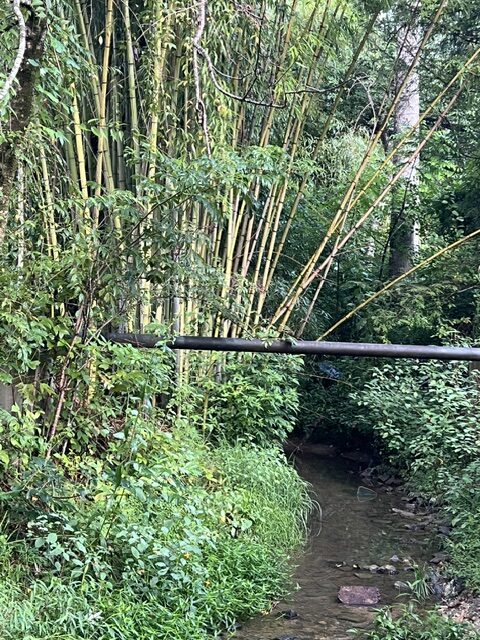
Continuing downstream away from houses and backyard I entered what felt like a green tunnel—aquatic weeds at my feet, grasses and wildflowers along water’s edge, thick green shrubs spreading from each bank, and a dense verdant canopy of leaves above. Other colors too—bright yellow wild sunflowers, orange jewelweed, small black-winged dragonflies, gray-brown minnows darting in the water, and tan sand and multicolored rocks on the streambed.

Micro-Macro.
As I walked, I noticed that my little unnamed creek had many features of a big river. I saw miniature sandbars formed along the side, quiet deeper pools beneath overhanging branches, and short and long shallow mini rapids. Mostly the creek had a sandy or rocky bottom but in a few places my feet sank into soft mud.
To my surprise I saw a tiny little tributary joining my creek. I also saw a spot were high water had carved a second channel parallel channel. This, I later read, is part of a river’s endless striving to find the most efficient channel. Noticing all these little creek-big river similarities I began to feel a growing respect and admiration for the little stream.
Strenuous.
Progress was slow. I had to carefully place each footstep and maintain my balance on the uneven and constantly changing creek bottom. I frequently encountered obstacles—a fallen tree to bend under, stretches of dense overhanging rhododendron branches to push aside, a net of native muscadine grapevines to bushwhack through. And when I ventured upstream, I had to traverse a long, dark culvert carefully feeling my way with my feet.
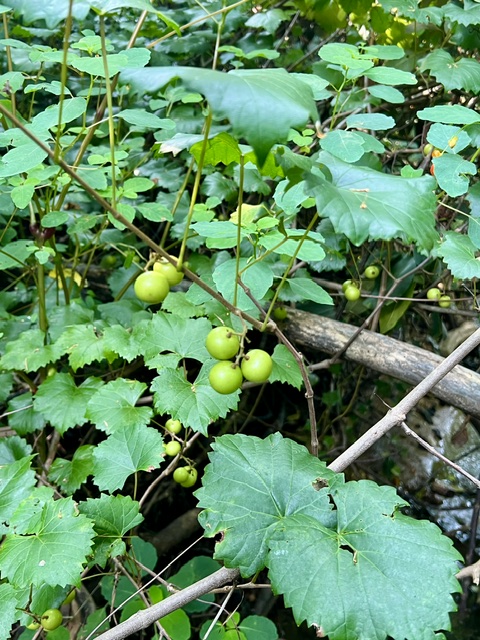

I learned that a creek walk demands full attention. Absorbed, the time and distance flew by. When I finished, I was surprised that I had walked for over an hour and had covered a mile and a half. I was tired from the effort but also pleased and satisfied because I knew that focused attention deepens nature connection.
Postscript
After a sit spot, it often takes me days or even weeks to process and understand the effects—what I learned, what I need to learn, the mental, emotional, and spiritual impacts, and how I might want to choose new behaviors. Often, I feel shifts inside but since I am exploring unfamiliar territory, I struggle to find the right words. What follows is not complete or perfect, but what I have so far gleaned from my sit spot alongside and my walk in the little creek.
My sense that riparian zones are vital channels of life was confirmed. I heard and saw birds and insects move alongside the water. I saw the rich variety of vegetation growing within and alongside the flowing water. I felt the moving water touch my feet and legs. And I learned that even a tiny stream attracts children and creek walkers. I recognized the creek’s enlivening effects on the landscape.
My attitude toward the stream evolved. For a week before my sit spot, I had sipped morning coffee on the deck and enjoyed looking down at the flowing water and hearing the soft burbling, but I still saw it as not much more than a simple backyard drainage channel.
After the sit spot and walk I gained admiration for the creek, for all the aquatic life and surrounding flora it encouraged and supported. I gained respect for its role, however small, in a massive and important watershed, a tiny vein in a vast and coherent circulatory system.
In his book, Is a River Alive? Nature writer Robert Macfarland advances the timely idea that every stream and every river is a living being with a unique identity and spirit. I felt this.
He explained that rivers are our partners in life. “Our fate flows with that of rivers and always has.”
*********
For more information on creek walking and guidelines for conducting a creek walk here is a link to a good blog: https://friendsofturtlecreek.com/creek-walking-whole-new-way-explore-turtle-creek/
To take a literary river journey and to learn about the identity and rights of rivers I highly recommend Is a River Alive? by Robert Macfarland. He is one of my favorite nature writers.
Thanks to Dr. Lawrence Cohen for sharing his photo. He also photographs similar stunning fractal patterns of nature in deserts, mountains, beaches. and more.
4 thoughts on “Riparian”
Continue to enjoy each episode- excellent observations / a welcome read as I cannot currently do a creek walk / lack the mobility.
Welcome to the South- Hendersonville.
Glad you could join me mentally for creek walk. It was quite an experience. Glad you enjoyed the blog.
Great write up on riparian zones and the benefits of a “Creek Walk”. Following a little stream to the Gulf is cool….. I know well The French Broad as well as the confluence of the Ohio and Tennessee Rivers at Paducah, KY. Amazing how natures expresses itself in so many different surrounds. It is so important to seek it out! Thx John!
That confluence of the big rivers at Paducah must be amazing. You are right that when you seek out lessons and inspiration from nature that it flows your way.
Comments are closed.